
Support
Make the right
connection.
Find the information needed to configure, understand and use your equipment. Start with the exact model and the complete camera-and-lens combination.
Configuration & operation
What information should I send before choosing a system?
Send the exact camera body and lens model, any existing lens board or back interface, the subject size and intended use. Include the rail or camera model if you already own a SWEBO system.
Does a mechanical interface guarantee full compatibility?
No. The interface is one part of the combination. Flange distance, lens coverage, rear-element clearance and bellows compression or extension also matter. Confirm the exact equipment combination; mechanical fitting alone does not establish electronic functions.
Does 0.01 mm per division mean 0.01 mm positioning accuracy?
No. Travel per division is a scale increment derived from the screw lead and dial divisions. It is distinct from measured positioning accuracy or repeatability. Available increments and upgrade options are model-specific.
Are lens boards and camera interfaces included?
Supply differs by product. For the TC18, lens boards and camera/back interfaces are selected separately and are not included in the base price. Check the model’s included, optional and excluded items before ordering.
Can I interchange rails between all modular cameras?
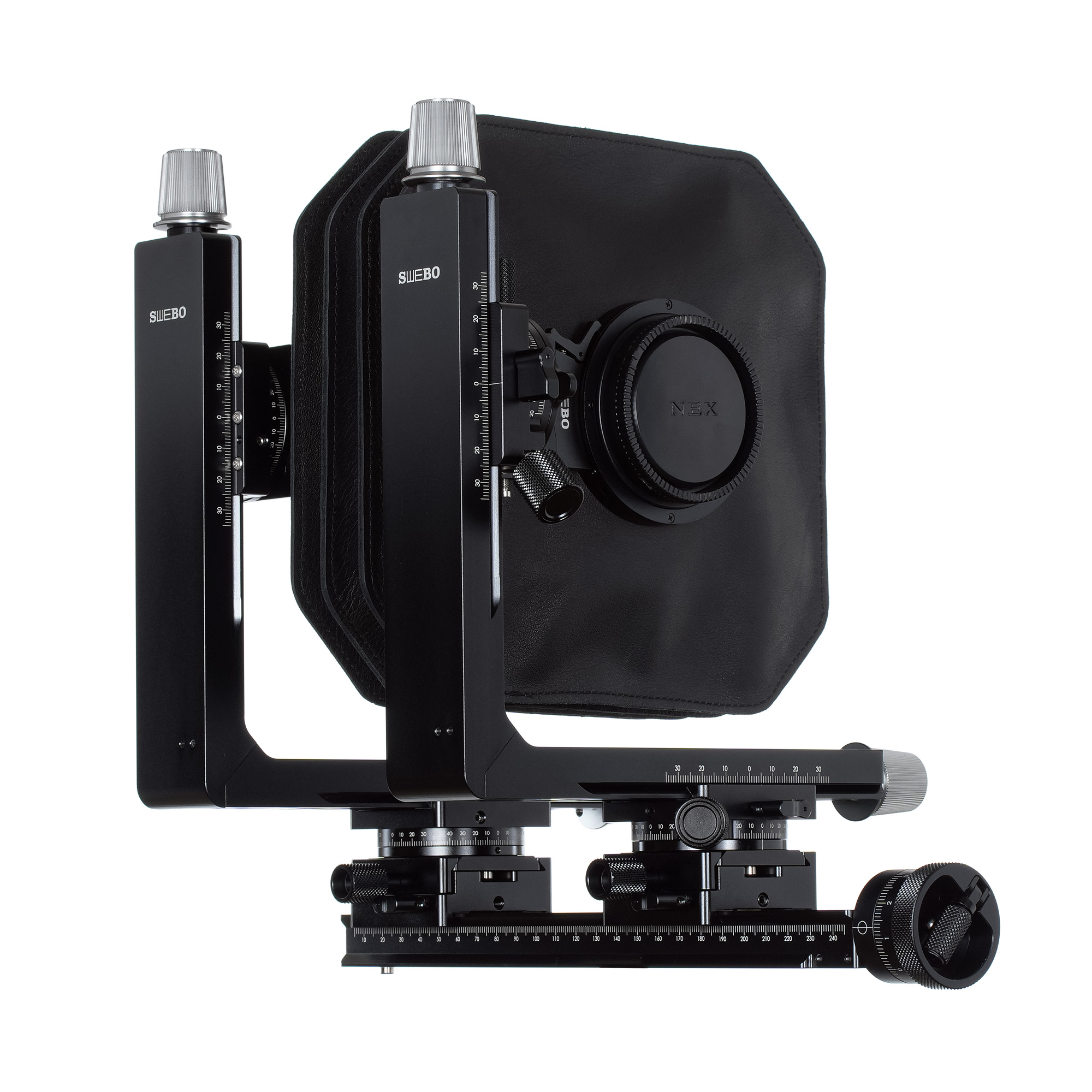
No. Check the exact model and part. The TCS20it uses a dedicated rail that is not interchangeable with other TCS20 rails.
How should I use the ND252 quick-tilt control?
Support the camera with your right hand while operating the quick-tilt lock with your left. Lock the quick-tilt axis before releasing the camera. Retaining friction does not replace physical support.
Where should I start with operation or maintenance?
Use the instructions for the exact model. Drive types and locking procedures differ. For example, the ND252 worm mechanisms are factory adjusted and should not be user-adjusted for tension or play; normal quick-tilt locking is a separate operation. Contact us if the behavior is unclear.