
ND252 Cube
Position quickly.
Refine precisely.
Why the Cube separates quick tilt from geared adjustment—and what that changes when you compose an image.
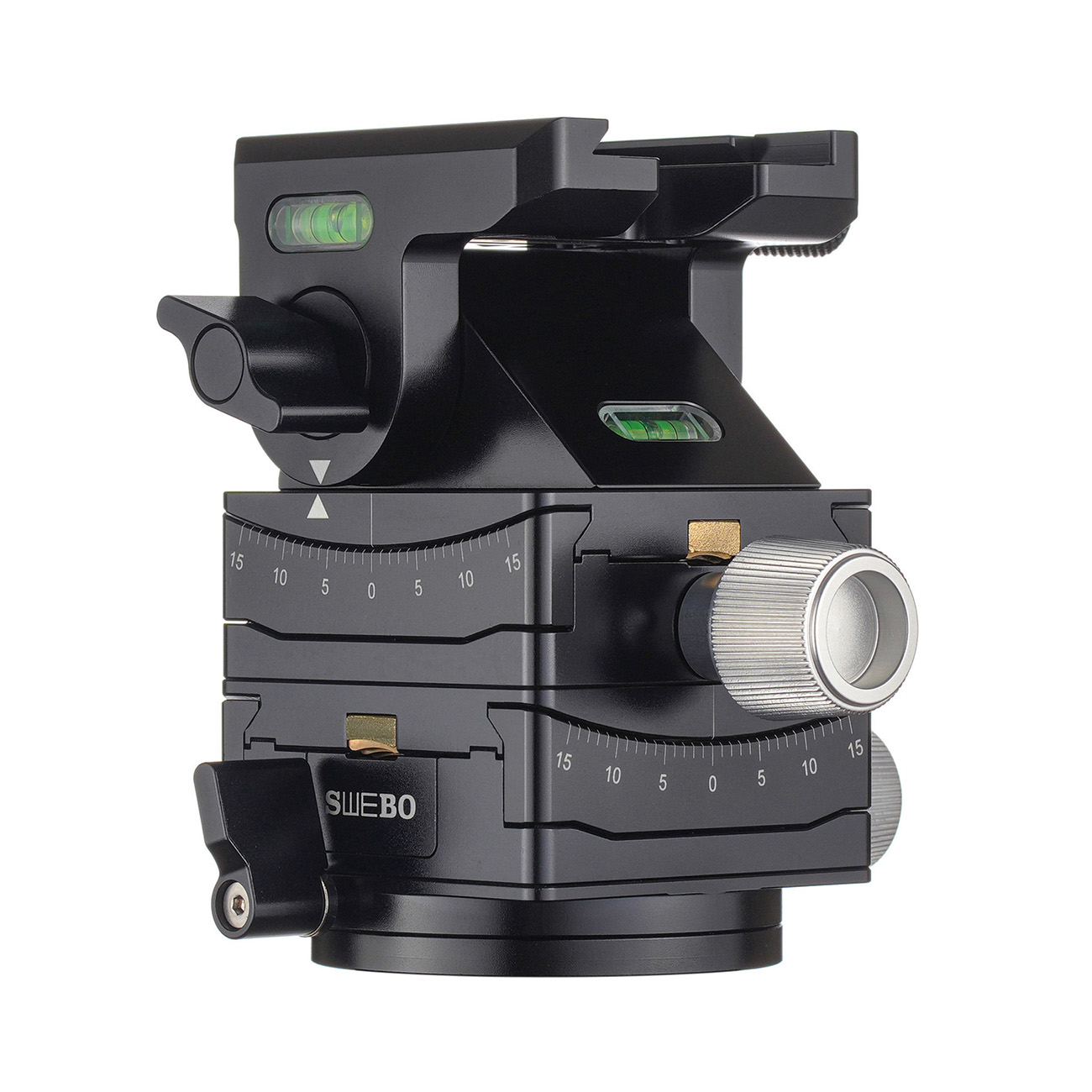
Finding a viewpoint and refining a horizon ask different things of a tripod head. The Cube gives each movement its own control.
A wide range. A fine adjustment.
A substantial change in camera angle and a small correction to the horizon are different operations. The first calls for movement through a useful range; the second calls for controlled, incremental adjustment.
The earlier ND2 used a small-diameter worm wheel on a single tilt axis to obtain a wide range of movement. Small-batch trials revealed limitations in operating effort, locking and the control of mechanical play. The development from ND2 to Cube took three years.
The resulting design divides the work between two separate, parallel tilt axes: one for quick positioning, the other for geared fine adjustment.
Give each movement its own role.
The Cube uses a large-diameter, arc-guided worm mechanism for fine tilt. This arrangement supports smooth, stable adjustment within a limited range. A separate quick-tilt axis supplies the broader movement, so a large change in angle does not require winding a geared control through the entire range.
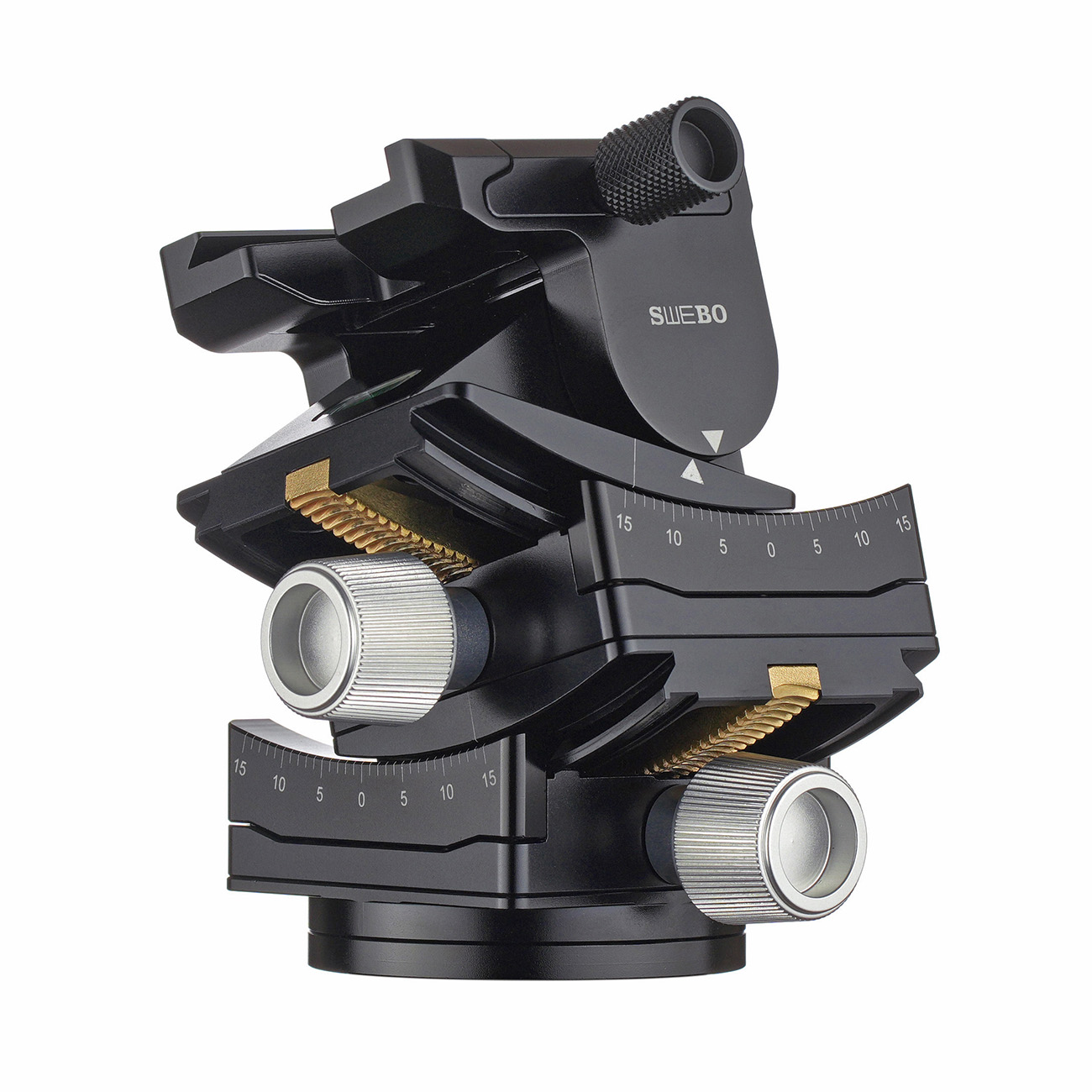
Geared tilt and horizon leveling each provide ±15° of adjustment. Both are self-locking and hold their position without a separate locking step. Together, the two tilt axes provide a combined range of 90° downward and 67° upward.
Establish the angle by hand.
Lock the quick-tilt axis.
Refine the composition with the gears.
One composition, three deliberate steps.
Establish the camera angle
Support the camera with your right hand while operating the quick-tilt lock with your left. Move the camera to the approximate shooting angle.
Lock the quick-tilt axis
Secure this axis before releasing your hold on the camera. Some friction may be retained during adjustment, but the camera must still be supported.
Refine the frame
Use the geared tilt and horizon controls for the final adjustments. These controls hold their position without an additional locking step.
This sequence suits landscapes, interiors and still-life work, while the quick change in angle also makes the Cube useful for everyday photography with conventional cameras and lenses.
Keep the camera close to its support.
The Cube is 100 mm high overall. Its compact construction keeps the camera close to the tripod’s support, while the fine-tilt axis sits closer to the camera axis than on the earlier ND2.
The 100 mm figure describes the overall head height; it is not a measured center-of-gravity height. The head weighs 670 g without the quick-release plate.
Build the connection around your camera.
The Arca-compatible clamp includes a 60 mm quick-release plate. The base provides 360° manual panning with a separate lock, and a 3/8-inch socket connects the head to the tripod.
An S64 panoramic module can be added above the head for stitched panoramas. It is optional and is not included with the ND252.
- Geared tilt / horizon adjustment
- ±15° on each module
- Combined tilt range
- 90° down / 67° up
- Overall height
- 100 mm
- Weight
- 670 g, excluding plate
- Recommended maximum load
- 10 kg
- Included
- 60 mm quick-release plate